
Why
Research by the GreenPaths partners shows that the decisions governments make can effect real change for many people in Europe and beyond. The convergence of the climate emergency, the economic crisis that began in 2007, the pandemic, and the war in Ukraine have increased inequality and weakened social cohesion. In this context, setting up a knowledge platform and creating a European network backed by scientific evidence of the impacts of climate and environmental policy interventions is sorely needed. The GreenPaths project derives from previous and ongoing work by the consortium partners around the green and just transitions, in particular on energy and climate, land use, transport, food, agriculture, construction, trade and taxation, and industrial production.
Purpose
For GreenPaths, ”green and just transitions”, means:
- A shift towards a sustainable model of production and consumption that prioritises the reduction of greenhouse gas emissions, adaptation and resilience policies, the protection of biodiversity, and the protection and restoration of ecosystems.
- A shift towards a social model based on equity and social cohesion, including fair distribution of the benefits and costs of the climate transition, to guarantee access to public goods and services, generate decent employment, and reduce inequalities.
- A shift towards greater citizen’ participation and expanded social dialogue that enables more democratic planning and implementation of the desired transitions.
Objectives
GreenPaths will improve the design, governance and implementation of policy strategies and instruments. The project pays particular attention to the European Green Deal, the Fit for 55 package, and the actions funded by the Just Transition Fund and the European Social Fund+.
These objectives will be achieved by a well-positioned consortium with ample experience on these topics through a comprehensive mixed-methods approach to be tested and grounded in a series of case studies, which will lead to a more participatory and influential engagement with policymakers, civil society organisations and other relevant stakeholders.
Key objectives includes
- Mapping and explaining links between policies, environmental sustainability and social well-being.
- Identify and assess indicators and tools to analyse interactions between climate interdependencies, environmental sustainability and social well-being.
- Develop systemic, in-depth and innovative understandings of green transition policies and approaches vis-à-vis social impacts and trade offs.
- Offer new insights into the relevance and significance of institutional, regulatory and legal frameworks in Europe.
- Produce policy recommendations for desirable changes in European and national policies through a multi-stakeholder backcasting approach and the participatory design of lighthouse projects, and facilitate an enhanced civil society-stakeholder-policy dialogue on just transition pathways.
The Work Plan
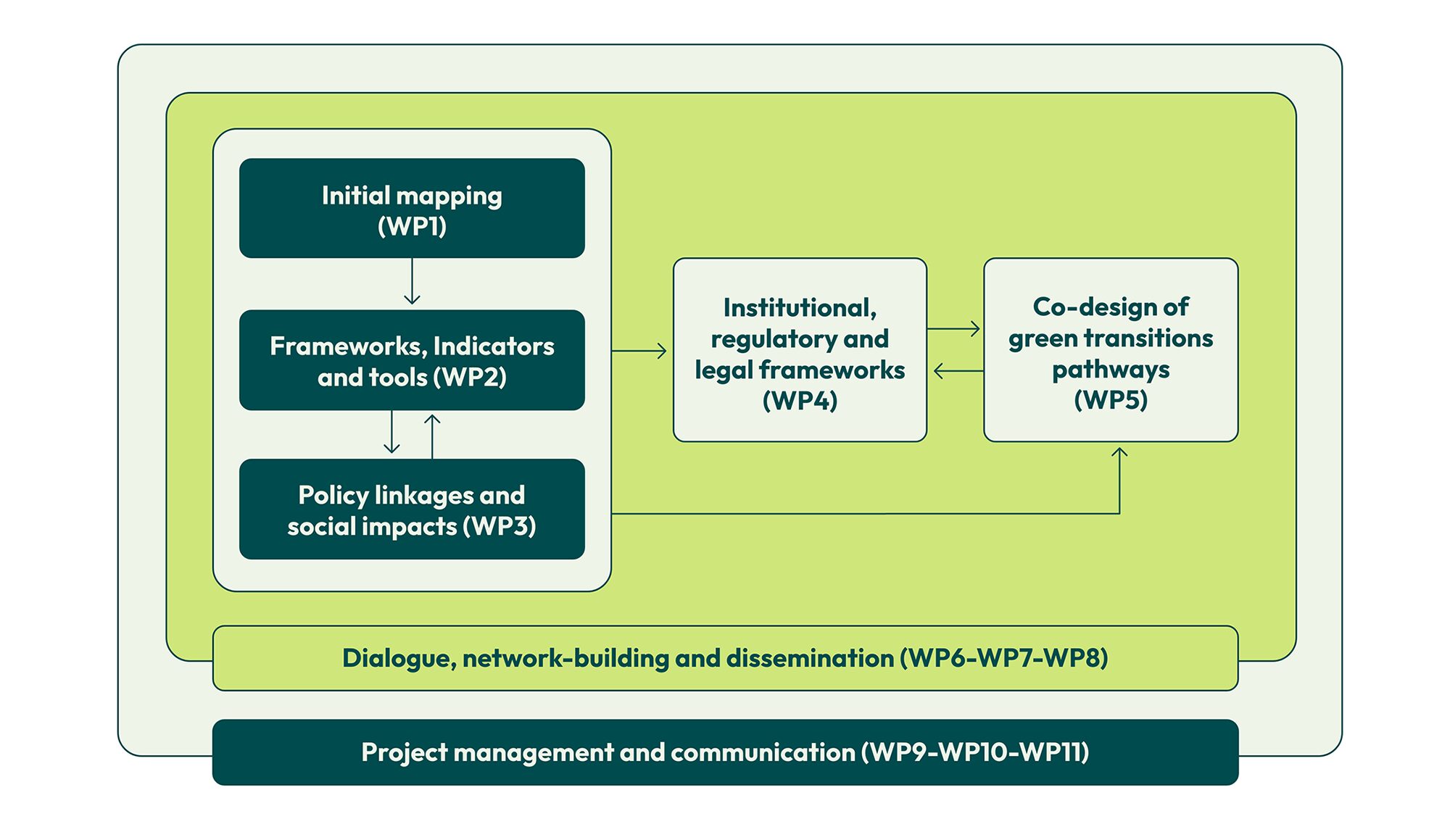
The GreenPaths project consists of 11 work packages (WPs):
WP1 starts with a broad mapping of policy-impact linkages using existing European and national indicators and databases. The outputs from the first packages will inform the refinement of the initial analytical framework (WP2), which will then be used in WP3 to conduct a set of 15 strategically selected case studies covering a range of national and regional backgrounds and issues, followed by a thorough analysis of the role of institutional, regulatory and legal mechanisms and structures (WP4). The case studies will generate additional empirical evidence that will contribute to an improved assessment of the relevance and usefulness of current frameworks, tools and indicators.
The project will conclude by establishing a permanent research and public information network with the launch of the European Knowledge Hub on Green Transitions (WP5, WP6, WP7 and WP8).
WP9, WP10, and WP11 are dedicated to the project’s management.
Work Packages